Do Golf Ball Dimples Provide A Reason to Smile?
Golf ball design is a subtle engineering problem with a delicate balance of dimple depth.
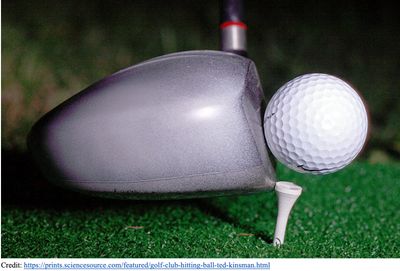
A golf ball seems like a simple object at first glance. However, its distinctive pattern of dimples hides aerodynamics that allow it to travel far beyond what a smooth ball ever could. These dimples reduce aerodynamic drag – the force that resists motion through air – by directing the flow of the thin layer of air that clings to the ball’s surface as it flies.
The biggest aerodynamic difference between a smooth sphere and a golf ball is found in the behavior of the “boundary layer,” which is the thin layer of air that flows along the surface of the ball. For a smooth ball, this boundary layer separates early, creating a large turbulent wake behind the ball, resulting in high drag. Dimples, on the other hand, disturb the air in the boundary layer, which delays separation of air from the ball and dramatically reduces drag.
It is well established that dimples reduce drag, but not all dimples are created equal. Their size, shape, spacing, and depth all come into play. Among these factors, dimple depth is especially important because it directly controls how strongly the surface roughness interacts with airflow. To investigate this phenomenon further, a 2019 study focused on one deceptively simple question: how does dimple depth affect the drag experienced by a golf ball in flight?
To isolate the role of dimple depth, the authors turned to fluid dynamics simulations. They modeled five golf balls that were identical apart from their dimple depth, which ranged from 0.6 to 1.5 millimeters. A smooth ball with no dimples was also included as a point of comparison.
A key aerodynamic feature of a golf ball is the so-called “drag crisis” where a sudden drop in drag occurs when the boundary layer transitions from laminar to turbulent flow. This study shows that dimple depth has a strong influence on when this transition occurs. Balls with deeper dimples experience this transition at lower airspeeds.
Early transition, however, is not the whole story. The authors further found that while deeper dimples lower the speed at which drag reduction begins, they also lead to a higher minimum drag once the ball is at a high speed. That is, balls with shallow dimples achieved the lowest minimum drag coefficients, whereas balls with deeper dimples never quite reached the same level of aerodynamic efficiency.
From a physics perspective, deeper dimples cause the boundary layer to become turbulent earlier in a ball’s flight. This early transition helps reduce drag sooner compared to balls with shallower dimples, which require higher speeds to achieve the same effect.
This study’s findings remind us how fickle field aerodynamics can be. Golf ball design is a subtle engineering problem. Dimple depth cannot be optimized as simply “deeper” or “shallower.” Instead, designers must weigh competing effects: lowering the critical speed for drag reduction versus minimizing drag once that regime is reached.
Differences of fractions of a millimeter in dimple depth can meaningfully reshape airflow, wake structure, and aerodynamic performance. Tiny dimples make a very big difference, at least in golf ball aerodynamics.